Since pioneer work by Herbert Simons in the 1960’s and by Tversky and Kahneman in the late 1970s, behavioral and economic research have provided a strong foundation for the scientific study of decision making that accounts for the diversity of rational and less-rational motives and processes impacting choice and behavior, both at the individual and aggregate level. Of particular interest is financial decision-making, because financial decisions are among the most important life-shaping decisions that people make.
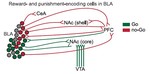
Understanding how the brain acquires, stores and retrieves information to cope with this uncertainty is at the forefront of decision neuroscience. If one takes a step back, it becomes evident that the same paradigm—acquisition, storage, retrieval of information—can be used to explain simple behaviors used by animals to survive in their natural environment. It is therefore not surprising that primitive brain areas associated with reward, fear, and memory, also constitute the foundation of both animal and human decision-making. Therefore, animal models allow researchers to probe basic reward-seeking behaviors while recording responses and manipulating activity at the circuit or single-neuron level to better understand the neural mechanisms of valuation, reward prediction, and error-driven learning.

Mike Cisneros-Franco
Postdoctoral fellow
Doing research at the intersection of Neuroscience and Economics
Publications
Bidirectional Control of Risk-Seeking Behavior by the Basolateral Amygdala